In January 2026, the UK's restrictions on advertising less healthy food and drink came into force. Paid online ads for identifiable products that are high in fat, salt and sugar (HFSS) are now banned outright, and those same products cannot appear on television or on-demand services before 9pm. The advertising regulator has already begun enforcing the rules, upholding its first complaints against paid online ads.
But the new framework runs on a single word: identifiable. The restrictions apply to ads that show an identifiable less healthy product. They do not apply to brand advertising that keeps the product itself off screen. That brand-only exemption has become the most important line in the policy for any chocolate, biscuit or crisp brand that still wants to buy paid media.
The strategic question for confectionery marketers is no longer only what to say about the product. It is whether the brand can do the work when the product is not in the room.
This is where we believe the ban rigs the game. Advertising without your product is only an option if you have already built something the audience recognises in the product's absence: a colour, a shape, a sound, a phrase. Those assets are not bought in a quarter. They are the compound interest of years of consistent brand building and millions in media value. The brands that own them can keep advertising more or less as before, simply leaning harder on cues they already have. The brands that do not, which is most challengers and most of the category's newer entrants, are left with far less to say in paid channels, or nothing at all.
A regulation designed to reduce children's exposure has, as a side effect, widened the gap between the brands that already have fame and the ones that do not. The Obesity Health Alliance has argued the brand exemption simply lets large firms test how far they can push. Whatever your view on the public health merits, the commercial effect is not neutral. It rewards accumulated brand equity.
There is a split inside the big brands too, and it is the one we found most interesting. Being a famous product is not the same as being a famous brand.
Some brands have made an icon of something that has nothing to do with what the product physically is. A pair of golden arches says nothing about how a burger tastes. A small tick says nothing about how a trainer performs. Yet each delivers the brand on sight, precisely because it is arbitrary and owned by one company alone. That arbitrariness is what makes it defensible, because no rival can credibly use it. This is the heart of Jenni Romaniuk's work on distinctive brand assets at the Ehrenberg-Bass Institute: an asset is only valuable if it is unique to you, not merely descriptive of the category.
The alternative is an asset built on the product itself, on how it feels or tastes, which is a far harder thing to own. We wanted to see whether that distinction held across some of the UK's biggest selling and most iconic confectionery brands. So we tested it.
We built four ads in the spirit of the new rules: brand cues only, with no product, no logo, no brand name and no category prompt. We chose four of the UK's most established chocolate brands on purpose. If any names can carry recognition with the product taken away, it should be these. We tested our graphics with 204 UK adults, evenly split by gender and across three age bands, and asked a simple question: what product comes to mind?
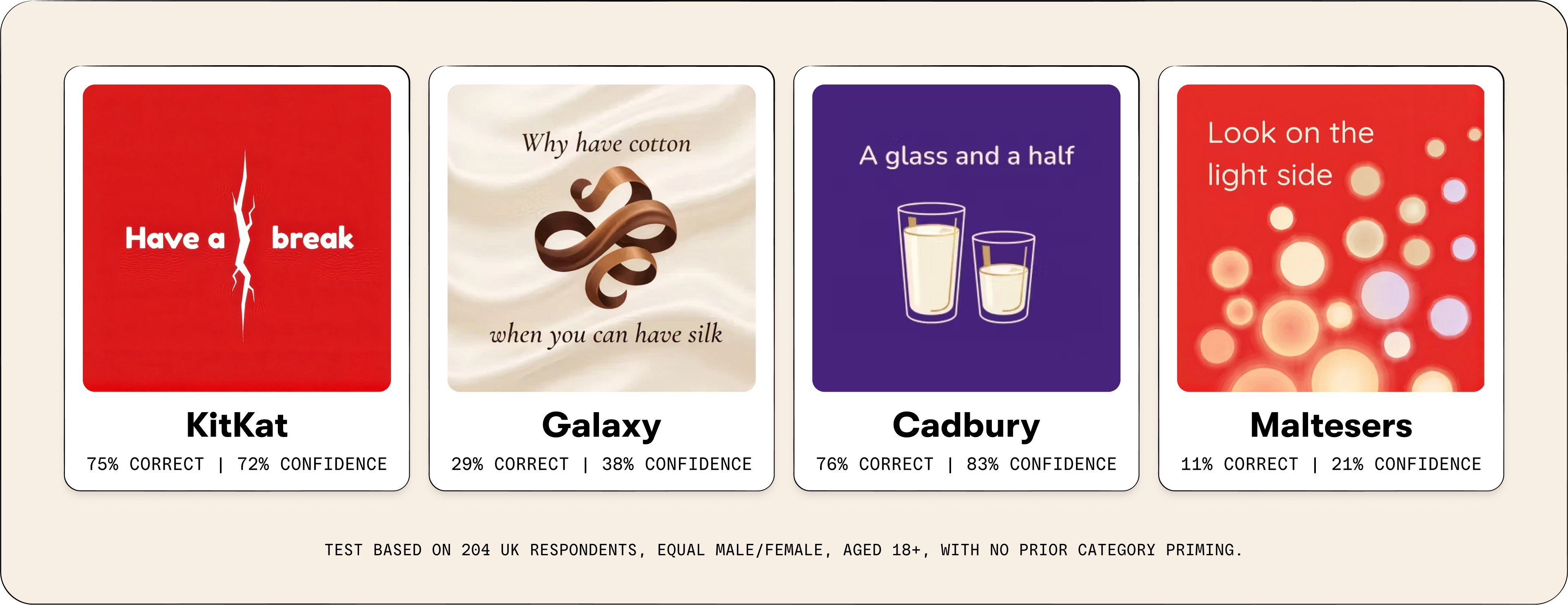
The results played into our 'product vs brand' distinction almost exactly. The two brands whose assets trade on an idea came out on top. Three in four people named the brand from the cue alone: 76% for Cadbury and its "glass and a half" (155 of 204) and 75% for KitKat and "have a break" (152).
The two brands whose assets describe the product's sensation fell far behind: 29% reached Galaxy and its silk (59 people) and just 11% reached Maltesers and its light, bubbly cue (22 people).
For KitKat the phrase did nearly all the work, with 75% pointing to the wording, and many simply finished the line for us. Cadbury spread its recognition across the slogan (50%), the glass and a half (29%) and the purple (16%), the signature of a brand with more than one asset to stand on.
The failures were the most telling part. Where the cue was weak, people did not hesitate. They confidently named the wrong thing. Only 21% felt confident about the Maltesers graphic against 83% for Cadbury, and among the 42 who did answer Maltesers with confidence, more got it wrong than right. Their guesses wandered to "Coca-Cola", "Fanta" and "light bulbs". Where a specific rival was named instead, it was almost always Aero, the one chocolate brand built entirely on bubbles. A distinctive asset that only describes your product will, sooner or later, describe a competitor's too.
Galaxy showed the other failure mode. Its silk cue got people to the category but not to the brand. 29% reached Galaxy, but a further 19% (38 people) got only as far as "chocolate" and stopped. Roughly half the sample knew they were looking at chocolate, yet under a third could name the brand. The asset got people to the aisle. It didn't get them to the pack.
This is what a descriptive asset does once the product is gone. A cue that names how something feels or tastes points at the sensation before it points at the brand, because smoothness, lightness and crunch belong to a whole category, not to a single company. So the cue drifts towards whatever else shares that sensation. An invented idea, a moment or a colour, has nowhere else to go. It can only mean you.
One pattern cut across all four brands; age changed recognition. The younger the person, the less they recognised. Adults under 35 identified KitKat 54% of the time against 85% for the over-35s, Cadbury 60% against 84%, and Galaxy 15% against 36%. Maltesers followed the same shape (7% against 12%), though the base is very small.
We would not overclaim from a single test, but the direction is worth noting, and it is not an isolated finding. Kantar's cross-generational advertising norms report that younger viewers tend to show lower brand recognition and are less able to name the brand behind an ad, with that ability rising as audiences get older.
Part of the explanation is where these assets came from. They were built, for the most part, in an era of shared mass television, when the same ad reached almost everyone at once. That world has thinned. Deloitte's 2025 Digital Media Trends describes younger audiences spreading their time across streaming, social video, gaming and audio, with no single channel gathering them the way TV once did. Marketing Week has written about the parallel problem of creative fragmentation, where brands cut hero films into social offcuts that build salience less efficiently than the originals ever did. If a generation never sat through the "have a break" films the way their parents did, it is not surprising the shorthand lands less cleanly.
That is an uncomfortable circularity. The ad ban exemption pushes brands towards asset-led, product-free advertising in digital and social. Digital and social are where the audience is most fragmented and where these inherited assets are already weakest, especially among the youngest buyers. The brands with the deepest asset banks are better equipped to absorb that. Everyone else is being asked to build fame under the exact conditions that make fame hardest to build.
None of this settles what any one brand should do. But it reframes the question the ad ban has handed the category. The winners under the exemption will not simply be the biggest spenders. They will be the brands that made themselves famous for an idea rather than only for a sensation, and can still be recognised with the product taken away.
For everyone else, the lesson is more urgent than it was a year ago. Build assets you can own, not just flavours you can describe, because the rules now reward the brands that can leave the product behind.
The good news is that this is knowable, not guessable, and the sensible move is to work it out before the media is booked. A Stickybeak Brand Health Dip can show how your own brand attributes are landing, a Competitor test shows where you resonate against the field, or you can build your own asset-awareness test in the spirit of this one.
Stickybeak turns any of these around with real consumer feedback in under 48 hours, so you can find out whether your brand, and not just your product, is doing the work. (It's free to create a Stickybeak account and take a look around).


.png)