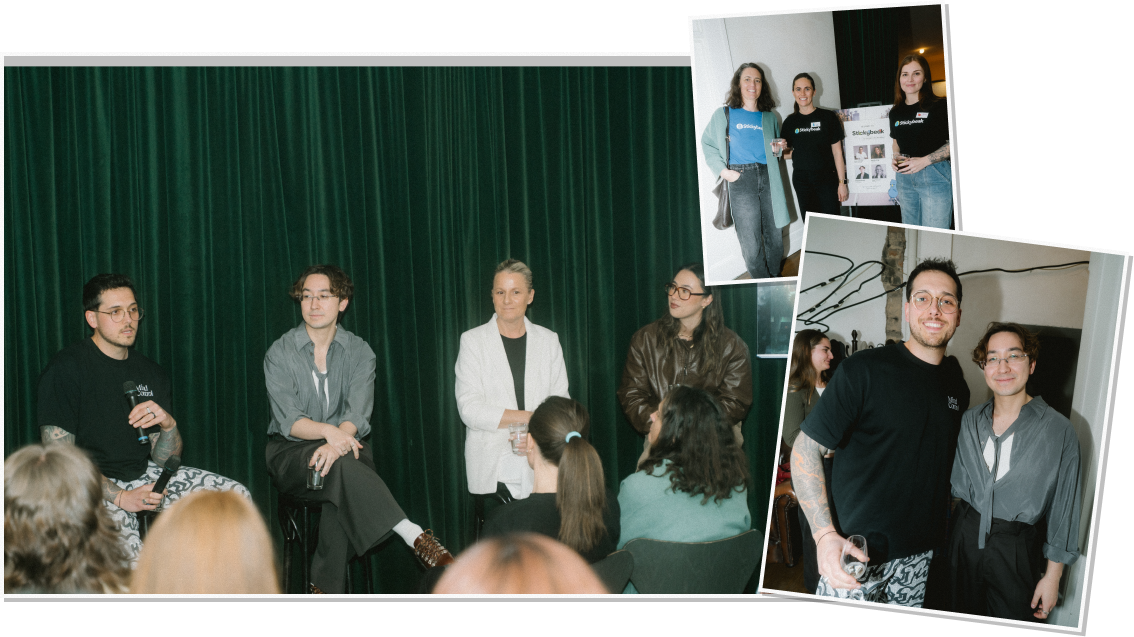
We hosted Stickybeak Sessions in Melbourne — a properly unfiltered conversation, with an incredible line-up: Brent Vrdoljak, Eugene Healey, Samantha Hansen and Maddie King. A room full of FMCG marketers and founders came along, and across ninety minutes we covered a lot of ground: why brand and performance were never really separate games, the importance of brand strategy and why you need to get your positioning down to a couple of sentences, and where AI earns its place in a marketer's toolkit rather than just taking over.
A few takeaways to think about:
Sam summarised it best in her approach: "At Raw C we're not afraid of big bets, but we test the stuff that could quietly sink a good idea, whether a pack moves product off shelf, or a claim lands the way we think it will." The big, brave calls — things like what to launch and who you are as a brand — still need to come from founders and marketers backing their own read of the market. What testing does is make these bets less risky before you find out the expensive way.
What started as a question about how brands should be spending money now, turned into a conversation about the importance of brand.
In a market where almost anything can be built or sourced, brand — the point of view, the taste, the thing that comes from the people actually running the business — is one of the few genuinely scarce assets left. The "brand vs performance" split got a proper working-over: most of what gets called performance is really just a media channel, and a channel doesn't decide whether you're building brand or not. The story you tell through it does. Brand building can happen on a "performance" channel, and you can run a purely functional ad on a "brand" channel.
Eugene is leading the way on strategy in a fragmented media context (he's just launched a course you should check out) — his challenge to us all was boiling it down to 'what's the idea?' Does your strategy make sense when you're briefing a new creator (or even 50 or 10,000 creators at a time)? Can you explain your strategy to a room that doesn't live and breathe the brand? Can you say your positioning in a couple of sentences, and have your grandmother, a 21-year-old and your CFO all actually get it? If the answer needs a slide deck, a workshop, or a founder in the room to translate it, it isn't finished yet.
That matters more now than it used to, not less. The old model was linear — a positioning line handed down, interpreted by an agency, executed by a handful of trusted hands. Increasingly, that same line now has to survive being briefed to fifty creators, or passed through a thousand people who'll never meet anyone from the business at all. A clear, simple idea makes that trip intact.
Nobody on the panel treated AI as either magic or a threat. The most useful reframe of the night was to stop calling it "AI" altogether and just call it technology — the same way every wave before it eventually got absorbed into "how things are done." Once you do that, the actual uses on show were refreshingly unglamorous.
One version: a thinking partner, not a strategist. Rather than a bench of consultants most businesses can't afford, one use was to stretch-test an idea the moment it exists — road-testing your own thinking before deciding who's actually worth paying to make it stronger.
Another version: a guardrail, not a ghostwriter. A brand's tone of voice, trained into a shared tool that lives on everyone's computer, so whatever a team member ships — a caption, a brief, a proposal — still sounds like the brand regardless of who typed the first draft. That's consistency at speed, not creativity by proxy.
A third, narrower version: execution once the thinking is already done. One example from the night was rough storyboard renders built to speed up a concept a team then rebuilds properly by hand, once it's already been approved. Useful, but only because the point of view existed before the tool touched it.
Those were the wins, but the failure mode was just as consistent across the room. Competent execution of nothing in particular is easy to spot — the AI-generated menus and stock food photography on any high street give the game away instantly. The panel's blunter version: most people shouldn't be touching creative generation and stopping there, and a business proudly showing off an AI-built internal tool that took months of engineering time is often just a slow, expensive way of arriving at something you could buy off the shelf for a fraction of the cost.
The pattern, in short: form the point of view yourself, then use AI to pressure-test it, keep it consistent, or speed up the bits that don't need a human hand. Skip that first step, and the tool just gets you to the wrong answer faster.
Four different topics, one shared thread: know your own point of view, and know exactly where you want evidence, brand and tools like AI to strengthen it rather than substitute for it. That's a good discipline for any marketer, and it's exactly the kind of night we want to keep hosting. We'll be back with the next one soon.


.png)